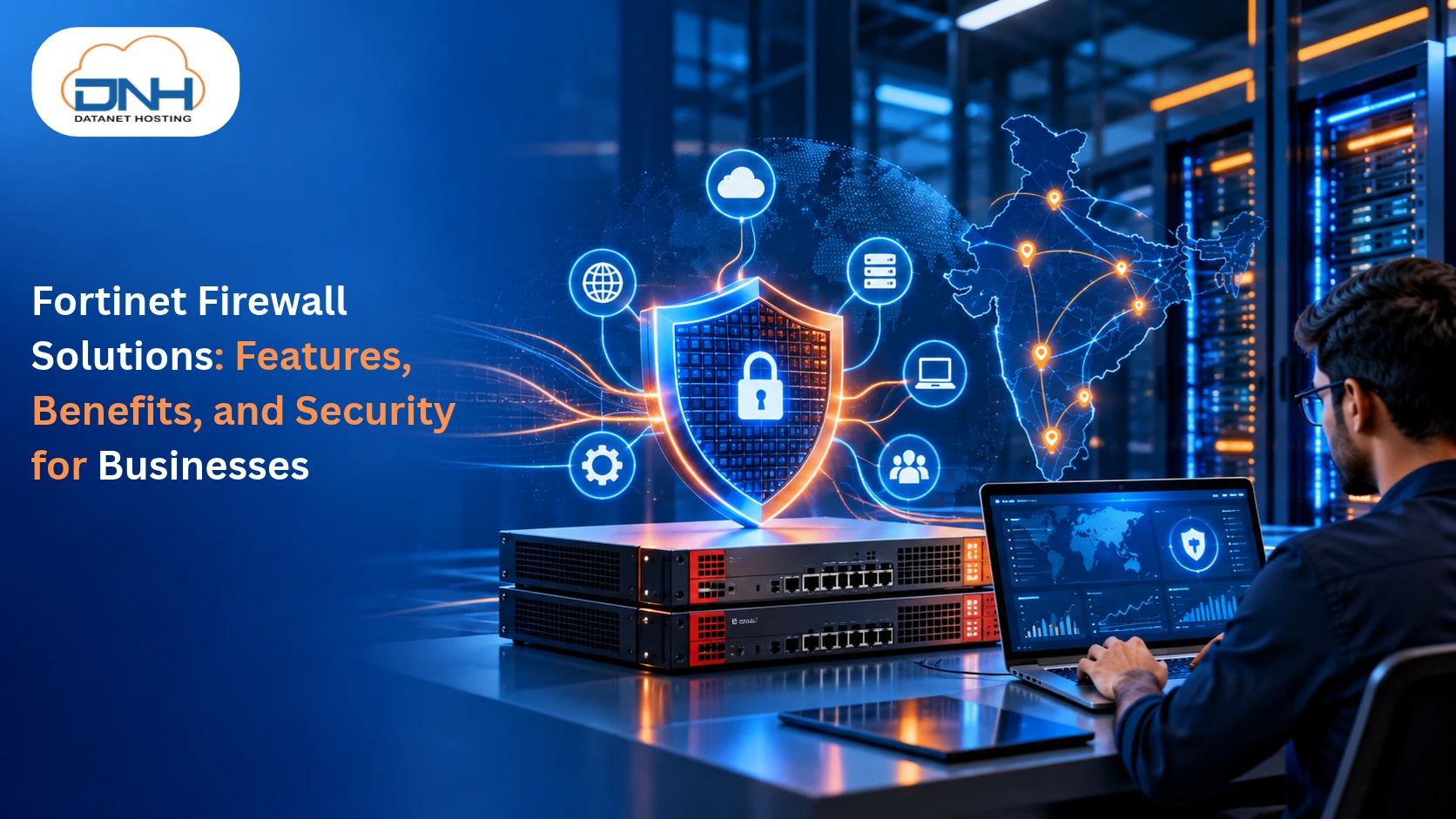
Modern businesses depend on connected systems, cloud applications, remote teams, and digital infrastructure to operate efficiently. However, increased connectivity also creates more opportunities for cyberattacks, unauthorized access, malware, and data breaches.
Traditional firewall protection may not be sufficient for organizations dealing with increasingly complex network environments. This is where Fortinet firewall solutions can help businesses strengthen network security, improve visibility, and manage access to critical resources.
With FortiGate next-generation firewalls (NGFWs), organizations can implement advanced network security controls designed to protect users, applications, servers, and business data.
In this guide, we explore how Fortinet firewall solutions work, their key features, business benefits, and how to choose the right solution for your organization.
A Fortinet firewall is a network security solution designed to monitor and control incoming and outgoing network traffic according to defined security policies.
FortiGate, Fortinet's firewall product family, combines traditional firewall capabilities with additional security features that can include intrusion prevention, application control, web filtering, secure VPN connectivity, and threat protection, depending on the model, configuration, and licensing.
Unlike a basic firewall that primarily filters traffic based on network rules, a next-generation firewall can provide deeper visibility into applications, users, and potential threats.
Businesses can deploy FortiGate solutions at network boundaries, branch offices, data centers, and supported cloud environments according to their infrastructure requirements.
As organizations adopt hybrid work, cloud computing, SaaS applications, and interconnected business systems, network security needs to evolve alongside their infrastructure.
A properly configured next-generation firewall can help businesses address several common security challenges.
Businesses face risks from malware, ransomware, suspicious network activity, and attempts to exploit vulnerabilities. Depending on the subscribed security services and configuration, FortiGate firewalls can help identify and block malicious traffic before it reaches protected systems.
Security teams need to understand which applications are being used, where traffic is going, and whether unusual activity is occurring. Application visibility and traffic monitoring help administrators make informed decisions about network access and security policies.
Remote employees and distributed offices require reliable access to internal applications and resources. VPN capabilities can help establish encrypted connections between authorized users, offices, and corporate networks.
Not every user or device needs access to every business resource. Firewall rules, network segmentation, and appropriate identity-based controls can help limit unnecessary access and reduce the potential impact of a security incident.
As organizations add users, applications, offices, and cloud workloads, their security infrastructure must scale accordingly. Choosing an appropriately sized firewall helps businesses accommodate growth while maintaining suitable security and network performance.
FortiGate firewalls offer a range of network security capabilities. The features available to an organization depend on its selected model, subscriptions, and deployment configuration.
Next-generation firewall capabilities combine traffic filtering with additional security controls to help organizations manage network activity and enforce security policies.
Businesses can use these capabilities to control network access, inspect traffic, and apply security rules based on their requirements.
An intrusion prevention system helps detect and block network traffic associated with known attacks and suspicious exploit activity.
When properly configured and maintained, IPS capabilities can strengthen defenses against attempts to exploit vulnerable systems.
Application control helps administrators identify and manage network applications according to business policies.
Web filtering can restrict access to selected websites and categories, helping organizations reduce exposure to malicious or inappropriate online destinations.
FortiGate solutions support VPN technologies for suitable remote-access and site-to-site connectivity requirements.
These capabilities help organizations establish secure connections between offices, remote users, and internal resources, subject to the chosen architecture and configuration.
Firewall logs, alerts, and reports provide visibility into network activity and security events.
Administrators can use this information to investigate suspicious connections, review policy effectiveness, and identify areas that require further attention.
Supported FortiGate models offer SD-WAN functionality that can help businesses manage connectivity across multiple network links and branch locations.
When integrated with security policies, secure SD-WAN can support centralized network management and more consistent security controls across distributed environments.
The right firewall configuration depends on the size of the organization, the sensitivity of its data, its network architecture, and its security objectives.
Small and medium-sized businesses often need enterprise-grade security without the complexity of maintaining a large security team.
A suitably selected FortiGate solution can help these organizations manage internet access, protect internal networks, establish secure remote connections, and introduce more structured security policies.
Enterprises typically operate complex networks spanning multiple departments, offices, applications, and data centers.
Next-generation firewall capabilities can support network segmentation, advanced traffic inspection, centralized management, and security policy enforcement across appropriately designed environments.
Data centers and hosting environments must protect servers, applications, and internal services from unauthorized access.
Firewall policies can help separate network zones, restrict unnecessary traffic, and control communication between workloads. The architecture should reflect the environment's performance, availability, and security requirements.
Organizations with several offices need consistent security policies and secure communication between locations.
Suitable FortiGate deployments can combine firewall protection, VPN connectivity, and supported SD-WAN features to simplify network security across distributed sites.
Selecting a firewall based only on the number of employees can result in an unsuitable deployment. Businesses should assess their current network requirements and anticipated growth before choosing a model.
Consider the following factors:
Number of users and devices: Estimate the number of employees, endpoints, servers, and connected devices that the firewall will support.
Internet bandwidth: Evaluate expected traffic volumes and future bandwidth requirements.
Threat protection performance: Review performance specifications with the security features you intend to enable, rather than relying only on headline firewall throughput.
Concurrent connections: Assess the number of simultaneous connections and the expected behavior of business applications.
VPN requirements: Consider remote employees, branch offices, concurrent VPN connections, and required encryption performance.
Network architecture: Determine whether the firewall will protect a small office, enterprise perimeter, internal network segment, data center, or cloud environment.
Security subscriptions: Check which security services and licenses are required for the intended deployment.
Scalability and support: Consider future expansion, configuration management, firmware maintenance, and technical support requirements.
A network assessment can help identify the appropriate model, deployment architecture, and security configuration for your business.
Purchasing a firewall is only one part of building an effective network security strategy. The way it is configured, maintained, and monitored also influences its effectiveness.
A structured deployment process should include the following steps.
Review existing network architecture, internet connections, applications, user access requirements, and current security controls.
Identify a suitable FortiGate model based on throughput requirements, security features, connectivity, and expected growth.
Configure interfaces, routing, firewall policies, administrative access, and other settings required for the deployment.
Implement appropriate secure connectivity and separate critical systems from general network traffic where the architecture requires it.
Verify connectivity, access restrictions, security policies, logging, and failover behavior where applicable.
Review firewall rules periodically, apply approved firmware updates, monitor alerts, and remove unnecessary access permissions. Document configuration changes and maintain suitable backup and recovery procedures.
These practices help organizations maintain a more consistent and manageable security posture over time.
Businesses need more than security hardware. They need a reliable security solution that fits their existing infrastructure, supports their operational requirements, and scales as their network grows.
Datanet Hosting Solutions is a Fortinet partner in India, providing FortiGate firewall and network security solutions for businesses in Noida and across India . As a Fortinet partner, we help organizations explore suitable firewall solutions to strengthen network protection, improve visibility, and secure their IT infrastructure.
Our Fortinet Firewall Services Include:
FortiGate Firewall Selection: Guidance on choosing the right FortiGate firewall based on your network size, traffic requirements, and security objectives.
Firewall Deployment and Configuration: Assistance with firewall installation, security policies, and network configuration.
VPN Implementation: Configuration support for secure remote-access and site-to-site VPN connectivity.
Network Segmentation: Help implementing access controls between critical systems and network zones.
Firewall Policy Review: Assessment of existing firewall rules to identify unnecessary permissions and potential configuration gaps.
Monitoring and Maintenance: Support for security logging, firmware updates, configuration reviews, and troubleshooting.
IT Infrastructure Integration: Assistance with integrating FortiGate firewall solutions into existing server, hosting, and network environments.
With expertise in hosting and IT infrastructure, Datanet Hosting helps businesses align network security with their broader IT requirements. Whether your organization is looking for an enterprise firewall solution in Noida, FortiGate firewall deployment, or network security support in India, our team can help you evaluate suitable options.
As a Fortinet firewall partner , Datanet Hosting aims to help businesses implement security solutions aligned with their infrastructure, operational needs, and growth plans. Implementation and ongoing support options can be tailored to your organization's requirements.
Looking for FortiGate firewall solutions in Noida or elsewhere in India? Contact Datanet Hosting Solutions to discuss your network security requirements and explore the right solution for your business.
Even a capable firewall requires ongoing attention. Organizations should adopt a consistent maintenance process to reduce configuration risks and improve visibility.
Review firewall rules regularly and remove outdated or redundant permissions.
Restrict administrative access and use strong authentication.
Keep firmware and subscribed security services appropriately updated.
Monitor logs and investigate unusual traffic or repeated access attempts.
Separate critical systems from less trusted network segments where practical.
Review VPN users and permissions when employees change roles or leave.
Maintain secure configuration backups and document significant changes.
Test business continuity and recovery procedures periodically.
A firewall should form part of a broader security strategy that may also include endpoint protection, identity and access management, vulnerability management, backups, and incident response planning.
A FortiGate next-generation firewall is a network security appliance or virtual solution that combines firewall controls with capabilities such as intrusion prevention, application control, and other security services, depending on the deployment.
Yes. FortiGate offers solutions for different network sizes. The appropriate model depends on traffic, users, enabled security features, connectivity requirements, and future growth.
Suitable FortiGate deployments can provide VPN-based remote access, allowing authorized employees to connect securely to corporate resources when configured with appropriate authentication and access policies.
Consider firewall throughput with enabled security services, internet bandwidth, concurrent sessions, VPN requirements, interfaces, licensing, and expected network growth. A professional network assessment can help determine the appropriate model.
Datanet Hosting offers Fortinet-related services, including firewall selection, deployment, configuration, VPN setup, policy reviews, and ongoing support options. The specific scope should be confirmed during consultation.
Contact Datanet Hosting Solutions and share your network requirements, current infrastructure, user count, and security objectives. The team can help assess your needs and discuss a suitable solution.
Modern network security requires the right combination of technology, configuration, monitoring, and ongoing maintenance.
Fortinet FortiGate firewall solutions can help organizations strengthen network protection, manage access, and secure connectivity across offices, data centers, and supported cloud environments.
Whether you are upgrading an existing firewall or planning a new network security deployment, Datanet Hosting Solutions can help you evaluate the options that fit your business.
Ready to strengthen your network security?
Contact Datanet Hosting Solutions to discuss your Fortinet firewall requirements and request a consultation. Request a Free Fortinet Firewall Consultation