
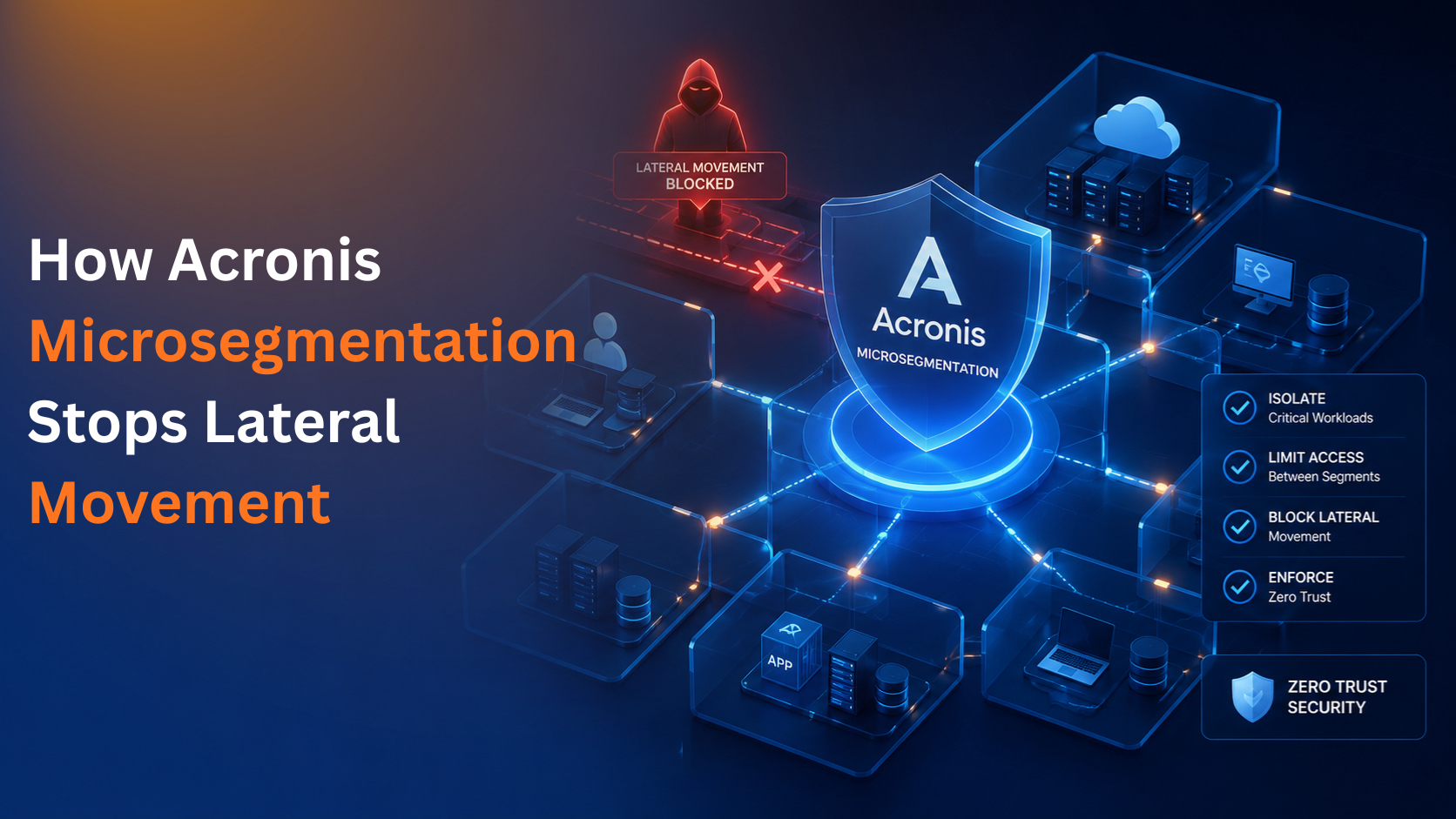
Cybersecurity is no longer just about keeping attackers outside your network. Today's attackers assume they will eventually find a way in—through phishing emails, stolen credentials, vulnerable applications, or compromised endpoints. Once inside, their next objective is to move across your environment until they reach valuable assets such as domain controllers, databases, backup repositories, or financial systems. This technique is known as lateral movement, and it is responsible for turning small security incidents into full-scale ransomware attacks and enterprise breaches.
Traditional network security relies heavily on perimeter defenses like firewalls. While these remain essential, modern hybrid environments require security controls that protect internal traffic as effectively as external traffic.
By dividing networks into isolated security zones with granular access policies, Acronis Microsegmentation helps organizations contain threats before they spread, making it an important component of a Zero Trust security strategy.
Lateral movement is the process attackers use after gaining initial access to a network. Instead of immediately stealing data, they quietly explore internal systems, escalate privileges, compromise additional devices, and search for high-value assets.
Credential theft
Pass-the-Hash attacks
Remote Desktop Protocol (RDP) abuse
PowerShell exploitation
Windows Management Instrumentation (WMI)
SMB exploitation
Privilege escalation
Internal reconnaissance
These techniques often use legitimate administrative tools, making them difficult to detect using traditional security solutions alone.
Many organizations still operate with relatively flat internal networks.
Once attackers compromise a single endpoint, they may have unrestricted access to:
File servers
Virtual machines
Backup storage
Application servers
Databases
Cloud workloads
Perimeter firewalls primarily inspect north-south traffic (internet to network), but they often provide limited protection against malicious movement within the network itself. Modern security architectures therefore require internal segmentation alongside perimeter defenses.
Microsegmentation is an advanced cybersecurity approach that divides IT infrastructure into small, isolated security segments.
Instead of protecting only the network perimeter, each workload, application, virtual machine, or endpoint receives its own security policies.
Identity
Device
Application
Security policy
Business need
Only explicitly authorized traffic is permitted.
Everything else is denied by default.
This aligns closely with the Zero Trust principle of "Never Trust, Always Verify."
Acronis applies workload-level isolation instead of relying solely on VLANs or traditional subnet segmentation.
Its security model includes:
Each server, virtual machine, endpoint, or application can have its own security boundary.
Even systems located on the same subnet can have completely different communication rules.
Only approved applications and systems can communicate.
For example:
HR systems communicate only with payroll servers.
Backup repositories accept traffic only from authorized backup agents.
Finance databases remain inaccessible to standard employee devices.
Instead of monitoring only internet traffic, Acronis inspects internal communication between workloads.
This prevents attackers from moving laterally after compromising a device.
Policies automatically adapt as workloads move across:
Hybrid cloud
Virtual environments
On-premises infrastructure
Remote offices
This eliminates manual firewall rule management while maintaining consistent security.
If malware infects one endpoint, Acronis isolates that workload before attackers can reach other systems.
Rather than allowing ransomware to spread across the organization, the attack remains confined to the compromised segment.
Example: How Microsegmentation Stops a Ransomware Attack
Imagine an employee unknowingly clicks a phishing email.
Laptop becomes infected.
Malware steals credentials.
Attacker accesses shared folders.
Domain controller is compromised.
Backup storage is encrypted.
Entire organization experiences downtime.
Laptop becomes infected.
Endpoint is isolated.
Access to servers is blocked.
Backup infrastructure remains protected.
Databases stay inaccessible.
Security team contains the incident quickly.
The attack remains localized instead of becoming an enterprise-wide crisis.
Stops Lateral Movement
Microsegmentation supports security frameworks such as:
NIST
ISO 27001
PCI DSS
HIPAA
CIS Controls
by enforcing strict access controls and limiting unnecessary connectivity.
Organizations are increasingly adopting:
Hybrid cloud
Remote work
Virtual infrastructure
Multi-cloud environments
SaaS applications
These changes expand the attack surface and make traditional perimeter-based defenses less effective.
Microsegmentation provides the visibility and granular control needed to secure modern IT environments without disrupting business operations. Industry experts increasingly view it as a core component of Zero Trust strategies for protecting distributed infrastructures.
To maximize the effectiveness of Acronis Microsegmentation:
Identify critical business applications.
Classify sensitive workloads.
Apply least-privilege access policies.
Continuously monitor east-west traffic.
Regularly review segmentation rules.
Integrate microsegmentation with endpoint protection, backup, EDR/XDR, and identity security.
Security is strongest when multiple layers work together rather than relying on a single technology.
At Datanet Hosting, we help organizations strengthen cyber resilience through enterprise-grade Acronis solutions designed for modern IT environments.
Our experts assist businesses with:
Acronis Cyber Protect deployment
Microsegmentation implementation
Backup and Disaster Recovery
Endpoint Protection
EDR/XDR Security
Cloud Infrastructure Security
Zero Trust consulting
24×7 technical support
Whether you operate a small business or a large enterprise, we help secure your infrastructure against evolving cyber threats.
Cybercriminals no longer rely solely on breaking into networks they succeed by moving silently within them.
Preventing lateral movement is essential to reducing the impact of modern cyberattacks.
Acronis Microsegmentation delivers granular workload isolation, least-privilege access, and Zero Trust enforcement to help organizations contain threats before they become business-wide incidents. Combined with backup, endpoint protection, and proactive threat detection, it creates a stronger, more resilient cybersecurity posture.
If you're looking to strengthen your organization's defenses against ransomware and advanced threats, implementing Acronis Microsegmentation is a practical step toward a more secure future.