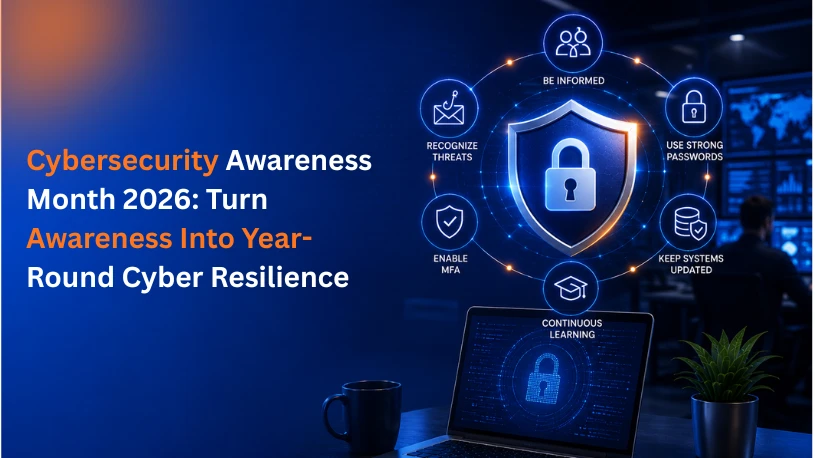
Cybersecurity Awareness Month 2026 arrives this October with a simple message: make life more difficult for cybercriminals. For businesses, however, that requires more than sending a security email, sharing a poster or asking employees to complete one annual quiz.
Real cybersecurity awareness changes daily behaviour. Employees know how to recognise suspicious activity, report it quickly and protect the systems and information they use. Managers understand their responsibilities, while IT and security teams support people with appropriate controls, monitoring and response processes.
October is therefore not the finish line. It is an opportunity to assess current risks, improve security habits and create a programme that continues throughout the year.
Cybersecurity Awareness Month is observed every October to help individuals and organisations improve online safety. The initiative began in 2004 through the National Cybersecurity Alliance and the U.S. Department of Homeland Security and has since developed into a widely recognised global campaign.
The National Cybersecurity Alliance’s 2026 message, “Don’t Make It Easy for Them,” focuses on the value of small, consistent security habits. The idea is practical: people do not need to make one perfect cybersecurity decision. They need to repeat safer actions whenever they use email, access business systems, handle data or approve a request.
For organisations, this means treating employee awareness as part of the security architecture not as a substitute for technical protection.
Business technology now extends across cloud platforms, remote endpoints, web applications, collaboration tools, email accounts and third-party services. A single employee may interact with several of these environments every day.
Attackers look for the easiest available route. That may be a reused password, a convincing impersonation email, an unpatched application, excessive account permissions or a backup that has never been tested. Even strong infrastructure can be exposed when people do not know what warning signs to look for or where to report them.
Cybersecurity awareness helps close this gap by connecting people, processes and technology. It gives employees a clear role in protecting the business while reinforcing the controls that reduce the impact of mistakes.
A generic presentation cannot address every role. Finance teams may face fraudulent payment requests, HR may handle sensitive employee information, sales teams may receive unexpected attachments, and administrators may hold privileged access.
Training becomes more useful when examples reflect the decisions each team actually makes.
A completed webinar proves that content was delivered. It does not prove that an employee can recognise a suspicious login page, verify an unusual request or report an incident correctly.
Awareness should be measured through practical outcomes, not attendance alone.
Vague advice creates hesitation. Employees need to know how to verify a request, whom to contact, what information to preserve and what to do if they have already clicked or shared information.
A fast, blame-free reporting process can help the security team investigate earlier.
Awareness cannot compensate for weak access controls, missing multifactor authentication, outdated systems or untested backups. Training and technology must support each other.
For example, employees can be taught to recognise credential theft while the organisation also implements stronger authentication, least-privilege access and login monitoring.
Security habits fade when they are discussed only once a year. Short refreshers, relevant simulations and regular reminders are more effective for keeping secure behaviour part of everyday work.
Review your infrastructure, applications, email environment, user access and third-party dependencies. Examine previous incidents, recurring support issues and any controls that have not been reviewed recently.
An expert-led security assessment and testing programme can help identify vulnerabilities, misconfigurations and exposure points before awareness topics are selected.
Build scenarios around real responsibilities:
This makes the guidance easier to remember and apply.
Use technical safeguards to reduce dependence on a single human decision. Important measures include:
Business email deserves particular attention because it carries credentials, approvals, documents and sensitive conversations. Managed email administration and security can strengthen account control, filtering, backup and recovery alongside employee awareness.
Employees should have one obvious way to report a suspicious email, unexpected login prompt or unusual system behaviour. The process should be fast, easy to remember and available to remote as well as office-based staff.
Avoid creating a culture in which people hide mistakes. Quick reporting gives the response team more time to contain potential damage.
No awareness programme can remove every risk. Organisations should know how they will respond if an account is compromised, an application becomes unavailable or ransomware affects business data.
Review incident ownership, escalation contacts, recovery priorities and communication procedures. Then test whether backups can restore the required systems within an acceptable time. Datanet Hosting’s cyber resilience and recovery services support disaster recovery planning, business continuity, backup monitoring and ransomware resilience.
Useful programme measures may include:
These indicators help leaders understand whether the programme is improving real security outcomes.
|
Week |
Focus |
Practical actions |
|
Week 1 |
Understand current risk |
Review assets, users, access, recent incidents and unresolved vulnerabilities. Establish baseline measurements. |
|
Week 2 |
Protect identity and email |
Reinforce multifactor authentication, password management, phishing recognition and request verification. |
|
Week 3 |
Practise role-based response |
Run department-specific scenarios and confirm that employees know how and where to report concerns. |
|
Week 4 |
Test resilience |
Review escalation procedures, test a backup restoration and assign owners and deadlines for outstanding actions. |
At the end of October, convert the findings into a quarterly improvement plan. Schedule short refreshers, periodic access reviews, vulnerability assessments and recovery exercises rather than waiting for the following year.
Sustainable awareness requires leadership support, defined ownership and policies that match how the organisation operates. Security responsibilities should be included in onboarding, role changes, vendor access, remote work and employee exit processes.
A structured governance, risk and compliance programme can connect awareness activities with risk management, security policies, regulatory obligations and audit readiness. This turns cybersecurity from an occasional campaign into an accountable business process.
Cybersecurity Awareness Month 2026 is a useful starting point, but awareness delivers greater value when it is supported by secure infrastructure, tested controls and a clear recovery plan.
Datanet Hosting helps businesses evaluate and strengthen their security posture through infrastructure, email, network and web application assessments; vulnerability assessment and penetration testing; governance and compliance support; and cyber resilience and recovery services.
Use October to move from awareness to action. Talk to Datanet Hosting about assessing your current security gaps and building a practical improvement roadmap for your business.
When is Cybersecurity Awareness Month 2026?
Cybersecurity Awareness Month is observed throughout October 2026. Organisations use the month to promote safer online behaviour, review security practices and strengthen cyber resilience.
What is the theme of Cybersecurity Awareness Month 2026?
The National Cybersecurity Alliance’s 2026 campaign message is “Don’t Make It Easy for Them.” It encourages people and businesses to repeat simple, effective security habits that make cybercrime more difficult.
How can a business participate in Cybersecurity Awareness Month?
A business can assess current risks, run role-based awareness sessions, reinforce multifactor authentication, test employee reporting procedures, review access rights and perform a backup recovery exercise. The most valuable activities should continue after October.
Is employee cybersecurity training enough to protect a business?
No. Training is one layer of cybersecurity. It should work alongside access control, patching, email security, monitoring, vulnerability management, backups, incident response and tested recovery procedures.
How often should cybersecurity awareness training be conducted?
Organisations should provide training during onboarding and reinforce it throughout the year with short, role-relevant refreshers. Additional training may be needed after a security incident, major technology change or significant policy update.