A finance manager at a mid-sized firm needed a quarterly summary pulled from a dozen scattered Excel files, three email threads, and a Teams call recording from the previous week. She could have opened a generic AI chatbot, described the situation in a prompt, and uploaded files one by one. Instead, she typed a single request inside Excel, and Copilot pulled the numbers, cross-referenced the email context through Outlook, and referenced the meeting notes automatically because it already had access to everything through Microsoft 365.
That's not a story about a smarter model. It's a story about an AI assistant that lives inside the tools a business already runs on, instead of asking the business to work around it.
That distinction is exactly what separates Microsoft Copilot from other AI chatbots in 2026, and why so many businesses are asking the wrong question when they ask, "which chatbot is smarter?"
Two years ago, AI chatbots competed almost entirely on model quality: who reasoned better, who wrote more naturally, who hallucinated less. In 2026, that gap has narrowed considerably. ChatGPT, Gemini, Claude, and Copilot all handle writing, research, coding, and image generation at a genuinely high standard.
What separates them now isn't raw intelligence. It's where each assistant lives, what data it can see, and how much of a business's actual workflow it can act on without a human copying and pasting between tabs. That shift is exactly why Copilot's positioning looks so different from a standalone chatbot.
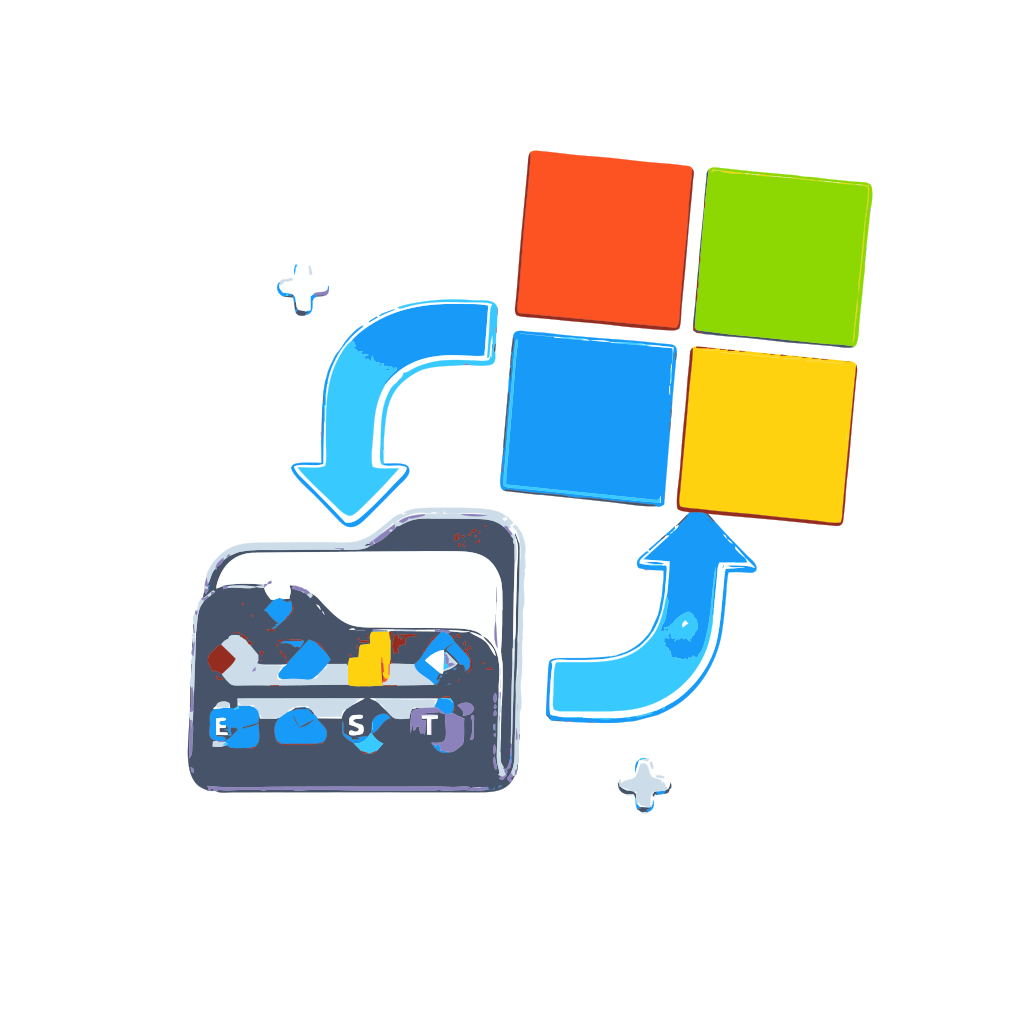
Copilot doesn't ask employees to leave Word, Excel, Outlook, or Teams to get help. It works directly inside those applications, reading the content of an open document or email thread and acting on it in place. For organizations already running on Microsoft 365, that means AI assistance shows up exactly where the work happens, not in a separate browser tab.
In its business tier, Copilot connects to Microsoft Graph, which means it can reference a company's own emails, files, chats, and meetings when it answers a question, provided the user already has permission to see that data. A generic chatbot starting from a blank slate simply can't do this without manual uploads.
Perhaps the most significant 2026 shift is that Copilot is no longer tied to a single model. Microsoft 365 Copilot can run OpenAI's latest GPT models for general tasks, Anthropic's Claude for deep reasoning and writing, and Microsoft's own in-house models for lighter jobs like voice, letting administrators pick the right engine for the task rather than being locked into one vendor's approach.
2026 has been the year of the "agent" across every major AI platform, and Copilot's version is built for coordinated, multi-step tasks across Microsoft 365 apps as well as custom agents created in Copilot Studio, rather than a single question-and-answer exchange.
Because Copilot is designed for regulated businesses, it ships with permission-aware data access, admin controls, and regional data handling options, including the ability to keep certain third-party models off by default for organizations bound by stricter data residency rules. That's a very different posture from a consumer chatbot built primarily for individual use.
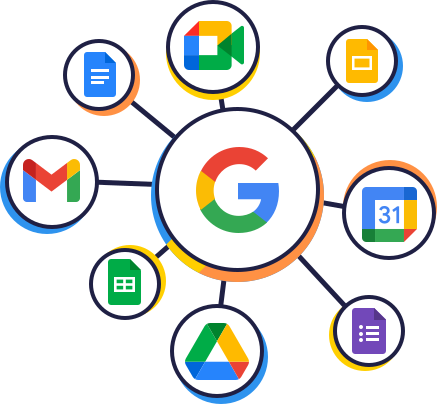
Ecosystem fit - Copilot is built for Microsoft 365 and Windows; Gemini is built for Google Workspace and Android; ChatGPT and Claude are ecosystem-agnostic standalone assistants.
The honest takeaway from every serious 2026 comparison is the same: no single chatbot wins on every dimension. The right choice depends on which software environment a team already lives in and what kind of work they're trying to automate.
ChatGPT remains the strongest pick for teams that want one flexible assistant not tied to any office suite, particularly for open-ended creative and analytical work.
Picking an AI chatbot is no longer just a personal productivity decision, it's an infrastructure decision. The assistant a business standardizes on determines how data flows, who can access what, and how much manual work still sits between an employee and their answer.
For businesses already running on Microsoft 365, Copilot's advantage isn't a smarter model, it's that the AI already knows where the files, emails, and meetings live. For businesses built on Google Workspace, Gemini offers that same advantage in a different ecosystem. And for teams that don't want to be locked into one office suite at all, standalone tools like ChatGPT and Claude still have a clear role to play.
Choosing the right chatbot is only step one. The harder part is deploying it securely, connecting it to the right data, and making sure it actually saves time instead of creating a new tool employees have to babysit.
At Datanet Hosting, our AI & Automation practice helps businesses go beyond picking a chatbot off the shelf:
Microsoft Copilot isn't different from other AI chatbots because it's smarter, it's different because it's woven into the software your team already uses every day, backed by enterprise-grade data controls and the flexibility to run more than one AI model underneath. Whether your business runs on Microsoft 365, Google Workspace, or a standalone AI tool, the right choice comes down to your existing infrastructure and how much of your workflow you actually want AI to touch.
Talk to Datanet Hosting's AI and infrastructure experts about which AI assistant fits your business, and how to deploy it securely, get in touch with our team today.