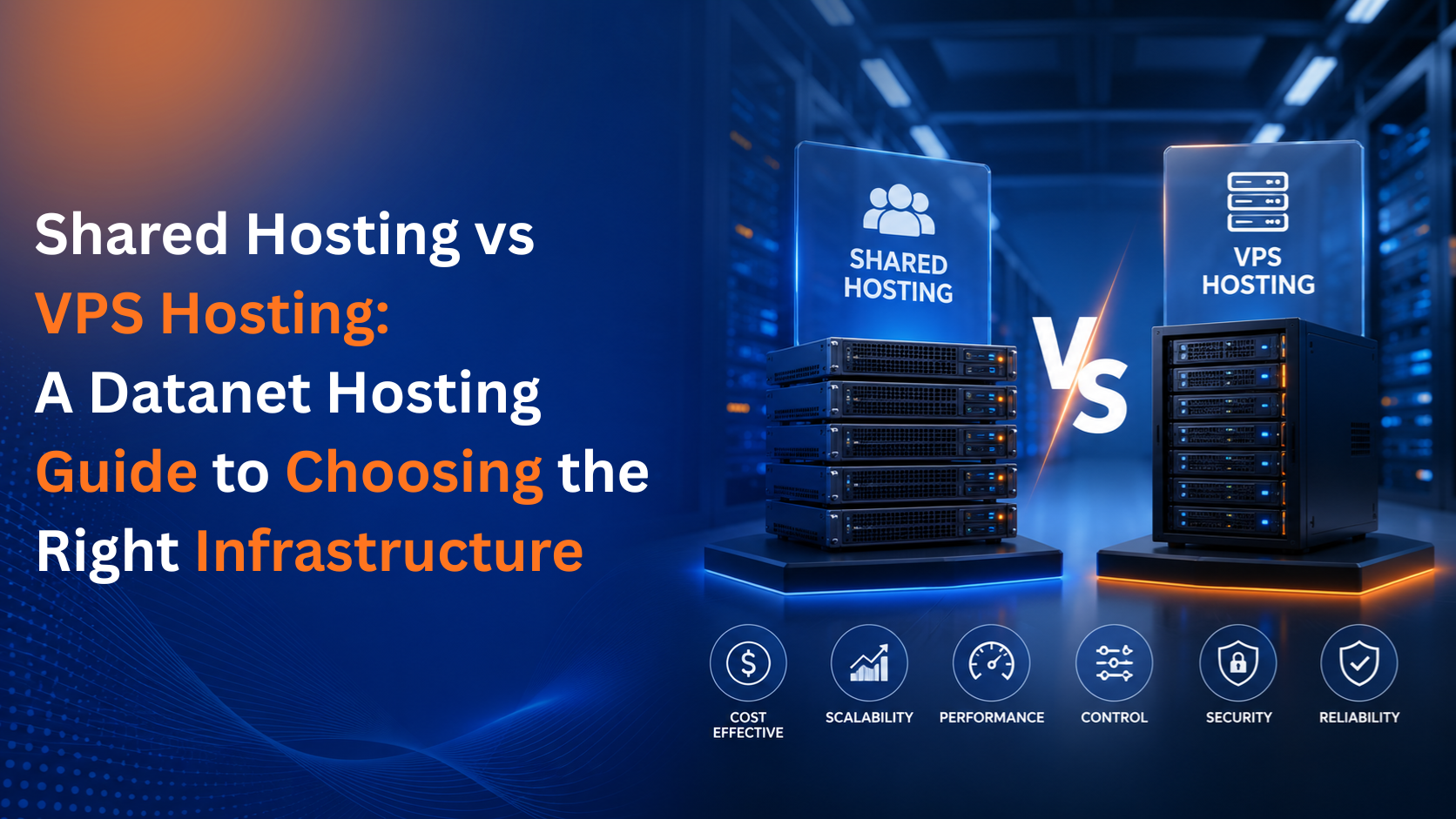
If your website has started loading slower, your admin panel feels sluggish during peak hours, or you've simply outgrown your current plan, you're facing a decision almost every growing business eventually runs into shared hosting vs VPS hosting. On paper it looks like a simple upgrade choice. In practice, it depends on your traffic, your applications, your budget, and how much control you actually want over your server environment.
At Datanet Hosting, we work with businesses across every stage of this journey from a first-time website owner on shared hosting to enterprises running mission-critical applications on VPS and dedicated infrastructure. Here's how to think through the decision properly.
Shared hosting puts your website on a server alongside many other websites, all drawing from the same pool of CPU, RAM, and storage. The hosting provider manages the server, security patches, and core configuration, while you manage your site through a simple control panel. It's built for ease of use and affordability.
VPS hosting (Virtual Private Server) also runs on shared physical hardware, but your website or application sits inside its own isolated virtual machine with dedicated resources reserved just for you. You're no longer competing with hundreds of other accounts for CPU cycles or memory you get a private slice of the server, with far more freedom to configure it the way you need.
Think of shared hosting as living in an apartment building where utilities are shared and managed for you. VPS hosting is more like owning a townhouse still part of a larger building, but with your own private space, your own utility meter, and the freedom to renovate as you like.
Shared hosting remains the smart choice for a large share of websites, especially:
The biggest advantages are simplicity and cost. With Linux Shared Hosting or Windows Shared Hosting, you get a ready-to-use environment, email hosting, and a control panel no server administration knowledge required. If you're running WordPress specifically, our WordPress Hosting plans are tuned for that environment out of the box. For most small businesses, that's exactly what's needed: reliable hosting without the overhead of managing infrastructure.
The trade-off is that resources are shared. If a neigh boring site on the same server experiences a traffic spike or runs inefficient scripts, it can occasionally affect overall performance, even with a well-managed provider keeping guardrails in place.
A VPS becomes the better fit once your website or application needs consistency, customization, or room to grow. Common signs you're ready include:
With VPS Hosting, you get dedicated CPU and RAM allocations, meaning your site's performance isn't at the mercy of other tenants on the server. You also gain the flexibility to configure your environment precisely something shared hosting simply isn't designed for.
It's also the more security-conscious option. Since your VPS is isolated from other accounts, you have direct control over firewall rules, access permissions, and hardening important for businesses handling sensitive data or working toward compliance requirements.
On shared hosting, resources come from a shared pool, so performance can vary depending on how busy neigh boring sites are. On a VPS, resources are dedicated and guaranteed, which means performance stays stable and predictable regardless of what else is happening on the physical server.
Customization follows the same pattern. Shared hosting keeps things simple by limiting what you can change at the server level, while a VPS gives you full root access to configure the environment however your application needs. Security isolation is stronger on a VPS too, since your virtual machine is walled off from other tenants, whereas shared hosting accounts share the same environment.
The one area where shared hosting has a clear edge is management effort and cost. It's provider-managed and minimal-effort by design, and it comes in at the lowest entry price. A VPS costs more and requires more oversight patching, backups, and monitoring all become your responsibility unless you choose a managed VPS, where your provider handles that layer for you. This is where working with the right hosting partner makes the difference between "more control" and "more headaches."
Start with your workload, not the price tag:
Whether you're just getting your first website online or scaling a business-critical application, Datanet Hosting offers a full spectrum of infrastructure to match from Linux and Windows Shared Hosting and WordPress Hosting, to VPS Hosting, Dedicated Servers, and fully Managed Enterprise Hosting. All plans come backed by 99.9% uptime, SSD NVMe storage, DDoS protection, and 24/7 expert support, so you're never left managing a problem alone.
The right hosting plan isn't the most powerful one available it's the one that fits your current needs while leaving a clear path to scale. If you're unsure where your website or application fits, talk to our hosting experts and we'll help you size the right solution from day one.